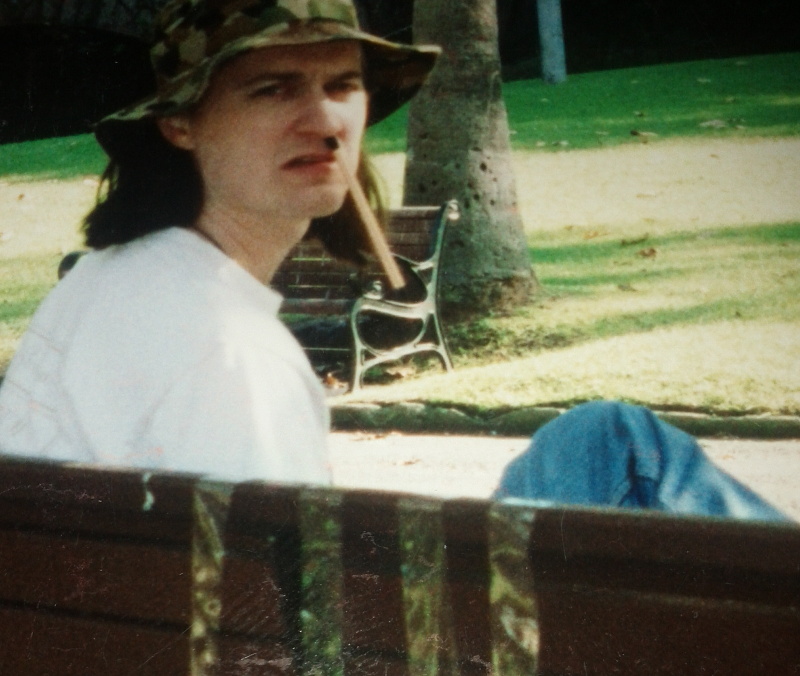
I still have the power to accept defeat
Neglectful Bob, it seems. Much time has passed ’tween the last and this entry in my journal. I am at Cafefour in Prague: that place next to the dreaded Pivrnec near Náměstí Republiky and a former place of employment dubbed EIN.
Earnest Intellectual Naivete.
Two kurvy have seated themselves facing me, babbling in Czech, still a foreign language despite my understanding. This place (Praha) is not home, NOR, it seems, was it ever. This feeling of displacement hovers intrudingly above my shoulders, never quite focused enough to glance out of the corners of my twitching eyes.
I left Vesna in Muenchen yesterday, imprisoned in her nursing job, as I rolled swiftly eastward vlakem. I miss her terribly. Our separation only enforced before, as it does now, my confirmation to myself that she is the woman I want to be with. Forever? Well, who knows what is forever and what is not, but I’ll take Vesna for a local forever, hoping at last to expand our life into a global context.
I am hardly even nostalgic about Prague. I do not need to rehaunt my old places of frequency, not teary eyed mourn a life that included people who are mearly appirations now – static eidolons in my memory, removed forever from the real peoples’ personas. Miro, Draža, Hynek, etc … ghosts.
Get lost, Ghost, indeed!
Final, most likely, messages from DANA:
And a word for someone I don’t know – tell her to try to make you happy and to have no fear. I’m just a shadow. No bitterness. I still have the power to accept defeat. (15 November 2000)
How about: I’ve recently discovered that the idea of zeuhl is not applicabale all the time. (17 November 2000)
Go astray / I won’t cross your way / So you can rejoy / Getting back an old toy / You pay a ticket to Charon / I am not there coz you’re gone. (19 November 2000)
I felt the same when you left for Bosnia. Probably you are not keen to hear my feelings. I simply feel the need to tell you. That’s all. No cynic Dana. A good trip. Bye, Creature. (19 November 2000)
I do remember. I will … for a long while. No joke. A unique thing. :) (15 November 2000)
Is there anything you need to add? Or everything is clear and we can end this pain. I cried enough today. It’s great to cry alone when people love you. (27 November 2000)
A message from long lost Hela:
I need some telling me that being hypersensitive is an advantage and I need to believe it at least 5 minutes. Anxiety is good, Hela, it makes you laugh afterwards. Fuck. (18 November 2000)
And one from Vesna:
You are the most important happening in my life. Much, much more important than my school. I was stupid to think it was not the truth.

This chapter begins in Praha in a café, unnamed, that I have spent many contemporary hours – plaintive minutes. It is a place for loneliness and only that. I espy a few instances when I frequented this hollow with others, but those were vapid and quickly forgotten liaisons.
Even once, I had a business meeting here during the summer, the fickle and directionless summer of the year 2000.
I finish my cigarette and call on the serving wench for another cappuccino. Displacement is the presentiment of the day – and will be for the next week. Before, there was always solace, a nestling place in Nusle where my bed, litres of alcohol, some cacophany some might dub music, and the intenet would always welcome me after frightful days, evenings and nights alone in the morass of the city.
Now there is nothing but changeable Jeníček to provide me temporary shelter for the evening and night. The drunken revelry that shall surely ensue will be boisterous, naturally, but sadly empty.
I am not here. My brain and heart were left in a messy flat in Munich with a girl from Bosnia. This enforced separation from her is absurd, a means to masochism, a detriment that may end in fruition of our bond or a severance. Sundered from my want, a need, I still sit at a candlelt table sleepy and alone. The tepid cappuccino being now prepared for my constricted gullet will be only of nominal help. I can only wait for the stupidity of the evening, hoping it will temporarily whisk away this feeling of desperate vacuity.
So I spark up another smoke.
Note to reader: I most often, as can be surmised, write when I am alone and devoid of happiness, companionship. I write when I am empty, ironically. So these words are conjured from nothing, have little bearing on the REALITY of my life. Sad but true. Yet I enforce this isolation. Without it, I would be displacing a part of myself, a fundamental facet of my personality. I displace the fullness and completeness of my life with this horrific spell of hated / loved solitude. Then I refill my vacant soul with the love and companionship I lack -- severely learn to miss -- during these escapades. It is an endless cycle -- one I fear that is impossible to break. May my loved ones by patient.
Later – at a different locale, a place to which before I have never been, actually. Quaffing another, better in fact, cappuccino, I sense the minutes creep slowly by. I wait for my meeting with Jeníček three quarters of an hour from now. This place began with the sensation of grandiose displacement. Do you know it’s Christmas? dribbled from the speakers hidden somewhere overhead. Now some modern hoopla stagnates in my ears. The nutmeg in the coffee is a slight assuagion. The serving kurva is typical Czech early 20s Andrew would like to shag-type. The walk from Náměstí Republiky bored me almost to literal tears. Peppered only with the spice of phone calls to Muenchen, the taste was, overall, bland. I perused one old haunt, to the chagrin of the writing on the previous pages, surely, near Národní Třida, a place that occupied my nights in late June, as well as emptying my pockets and eventually leading to the loss of my mobile phone.
Ah! The stupid old days! Yes!
This only ideallic moments of this year were those of August and early September. Of course, cynically, I fear they would, too, have lost their magic if they had lingered.
Now with Jeníček near Paleckého Náměstí. Better than expected. Actually, I can count him as the best friend I have here – that I made whilst here. Even better than Dana, methinks. Life is ok, though my last conversation with Drrrrling, whilst she was at Alex’s, was strained. All is good. Fuck Brynn and her idiot expressions. Life is moving on, though I remember the important bits and watch, only peripherally, the chaff waft away in the apathetic wind.
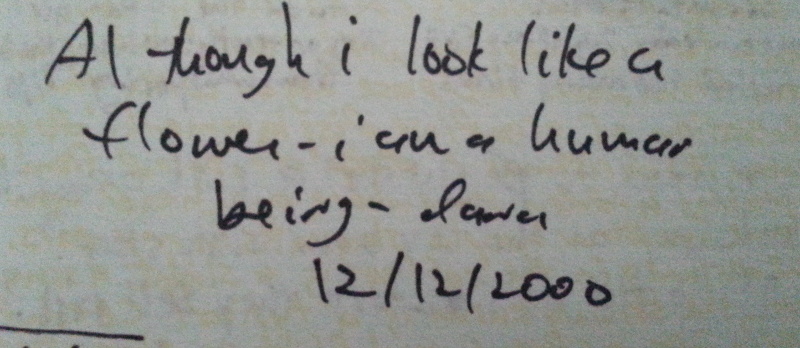
Always on the Fringes
Sad Saturday afternoon in Prague. Fifth cigarette to irritate my aching throat. Everyone is leaving. I am alone in this huge flat. I can hear the echoes of my footsteps for hours. Or maybe it is the throbbing if my pained head. I’ll light another one and watch the hours pass silently. I feel just like it is 1991, alone with my thoughts in the apartment I shared with John, trying to pen some inane poem to rot in a notebook until my eyes hunger for some sort of absurd nostalgia.
I have always been one to talk of the thrill of change, but now it tears at me like a feral beast. Humans begin to scurry in and out, removing Jenicek’s and Viking’s things, eyes always avoiding my own when I chance out of my cloister and into the emptiness of the remainder of the flat. This is an alien place after my time in Bosnia, in Munich. I am blind with hatred of the arena at which I have stared for two years, never quite joining the fray - always on the fringes.
Oouh!Your consistency is for the weak
The good news is that Dana and I are communicating again like good creatures should. The bad news is that I have Vesna here, also communicating well, happy and semi-satisfied. She said a few very poignant things last night with which I agree wholeheartedly. She said I should love her not because she is good for me, but because she is great. What she means is that I should love her for who she is, not what she does.
Dana said the exact same thing.
The way she is, not her doings, aspirations, etc, should be the reason I love her. I feel the same. Vesna loved Alex because he was good for her, not for who he was as a human. This she feels regretful for and, ultimately, it is why she left him.
One more cigarette (Tony’s ubiquitous lucky one) and my days as a smoker shall come to a close.
Oouh!Kde je Kapija?
Tuzla, Bosnia with Vesna. My right contact is irritating me. One moment. It is still irritating me, but I refuse to let its petty annoyance balk another few paragraphs of deft, incisive wit. See what I get after finishing A Confederacy of Dunces?
Back to the matter at hand: Tuzla and Vesna.
I was just informed by her, poking only the upper one fifth of her naked body out of the cracked bathroom door, thaht the icy water of the intermittent shower was too cold for Vesna. In this fabulous city, water is only supplied to a block of flats for two hours twice a day. We are scurrying to take advantage of it.
I took the early train to Muenchen yesterday, Adri seeing me off with her pedantic, lovelorn, witless dialogue accompanying. I saw Vesna for the first time in my life at 13.03 or thereabouts on the 29th of August, 2000.
Well, in the flesh for the first time.
Since then, most every moment has been spent together, as planned, including the not SO unpleasant ~13 hour bus ride to Tuzla. Arriving at 8 this Wednesday morning, we wondered blearily around the streets, returned to the flat (her flat) for hours of napping, coming a few centimetres of making love, discussing her husband, silliness of languages, movies and parallel thinking, and at last taking showers. She must meet her Aunt for a time and I’ll wander Tuzla.
Tomorrow our sites are on Sarajevo. Why not, after all?
My two concerns with Vesna are these: * The attachment she has to her husband. * The fear that I would tire of her as I do with all women I tend to hitch with no matter the initial seemingly spiffiness factor.
18.55
Vesna visits her aunt. I sit on a park bench near Kapija penning (in green) this. A kid spits from his perch upon the back of a yonder bench. His kamarad, sitting to his right, does not notice.
A few things about Vesna that make her adorable: * She lost her wallet and her train ticket on the UBahn immediately before arriving at the bus terminal seconds before the bus to Tuzla arrived. * She likes exploring hotels for the sole reason of absurd entertainment. Hotel Tuzla was an abomination, but we made an hour of it, shoe cleaning machine and all. * She is able to instantly forgive any fault, unlike Adri, she is not belligerantly idealistic. * She enjoyed our idiotic game of you are my burden, incomprehension, etc… * After a mere 24 hours, we speak to each other like we have know one another 10 years or more.
My idea of her has gone through several transformations. Originally, she was just another girl from ICQ, a Bosnian who interested me because Maja, being Yugoslavian, intrigued me. Gradually, she became an obsessive figure, one who claimed long distance, ridiculous love for someone she only had known from an internet chat medium. I played with her in this capacity and she played back, eventually calling me, leaving a phone number floating in the missed calls cache of my mobile. So it deepened into a full fledged infatuation on her side, calling me semi-regularly, urging me to call her at work when possible, and spamming the ICQ ports on each of our machines with emotionally inebriated broken English.
It waxed and waned time and again until last week.
Thursday.
She was to come visit me in Prague Monday (two days prior to this one), but we instead turned to conversation concerning her home town – the one in which I sit writing this and hearing herds of children clomp and scream about me. I decided arbitrarily that I would come this week. So, screwing Darius out of 15000 Kč, I was on my way yesterday morning, as I already mentioned.
At this time, Vesna was still a disembodied voice and a series of confused messages with an infatuation. She became real when I stepped off the train and saw her sitting on a bench, smiling her vivid grin, mouth open, cheek bones protruding beautifully. But she was now only a body and a mind with an infatuation.
Her gaze fixed on me unendingly.
The next to the last transformation happened on the bus last night when we started our carefully shy affection. She curled up into a fall in the seat beside me like her poor pet chicken, Sebastian, needing ever protection. By then, a bit of my natural paranoia had set in, disturbing this child-like image she had endued, pulling instead from her a series of why do you like me, anyway? questions.
And the final metamorphasis was today, after making (nearly) love, after my last entry when she stepped dressed out of the shower. She was a woman then – and a friend, someone I loved and trusted, could say anything to, and who enjoyed my company as I enjoyed hers. This is the kind of woman I want in my life.
Now what about her marraige to Alex?
A few minutes later – seated at Kapija –
in the middle of what one might call Náměstí Kapija there is a popcorn vendor. I love this town, though if another shell landed where one had in 1995, this absurd man would be the first to go. I would be incinerated, along with every smidgen of dribble in this book, a tenth of a second later.
I ordered a cappuccino in spite of this unlikely threat.
Thoughts claw at my conciousness: stay here! Stay here! Or maybe Sarajevo. Vesna could come visit often, though another abortive job in Muenchen would be more satisfying if my goal is to see her often, despite Alex. A good barometer for our future will be her feelings for me when she returns to Muenchen. Her vacillation so far has been happiness in me being her little secret and guilt, nervousness and frustration concerning the internal conflict between this adventure with me and her life with Alex. I hope the fact that I stay when she departs Friday does not injure things considerably.
Popcorn sounds tasty.
Another note about Tuzla: There are no bankomats ANYWHERE.
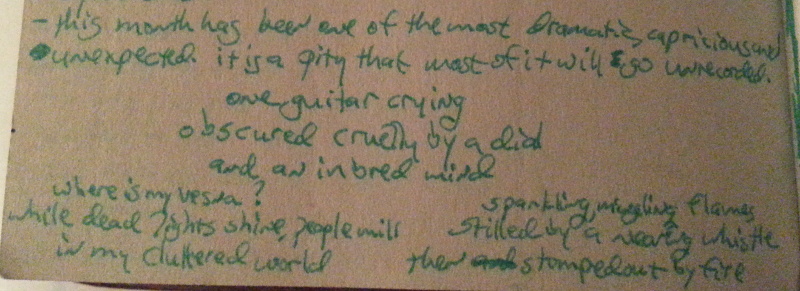
This month has been one of the most dramatic, capricious and unexpected. It is a pity that most of it will go unrecorded.
One guitar crying
Obscured cruelly by a dial
And an inbred mind
Where is my Vesna?
While dead lights shine, people mill
In my cluttered world
Sparkling, mingling flames
Stilled by a nearing whistle
Then stomped out by fire
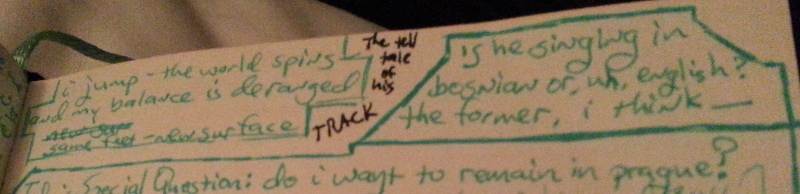
I jump – the world spins
And my balance is deranged
Same feet – new surface
Is he singing in
Bosnian or, uh, English?
The former, I think …
Today’s Special Question: Do I want to remain in Prague? The answer is NO.
Face it, I like this place because it is novel, more deeply sunk into the pocked face of Western Culture, a blight. I relate to it internal, as an isomorphism of my status as an outcast. There are most definitely fewer English speakers here, forcing me to make non-abortive attempts to learn the language if I chose to stay. Would I miss Vesna too much?
Today’s Special Comment on Vesna: I like her MUCH more than I thought I would. I am incapable of sustaining interest in my work. It is absurd, an abomination. Both my attitude and the topic of the work itself. I am descending into apathy, a whorl towards the apex of poverty threatens. The maelstrom pulls me. I am not resisting right now – not at all. I am not exactly
Oouh!Not Because She Dislikes Me
Time to try to fill this rectangle of white again. Present fills the air with sweet, ordered madness. Tomorrow brings yet another unknown: Vesna and Bosnia. To those avid readers who do not know, Vesna is a Bosnian girl that I “met” during my stint at 12Snap in Muenchen. She is now nervously chatting with me on ICQ, feeling uncertain about her decision to accompany me to Tuzla, Bosnia - her home town. It is not because she dislikes me or anything of the sort, but that she is married and her husband knows not of my existence.
I first met her on ICQ while avoiding doing some much more intellectually satisfying (surely) things at my windowside desk in the sweatshop-style office for the programmers of that abomination which was/is 12Snap. Procrastinating making progress on the abortive payment server, I checked the ICQ whitepages to see if there were any German sheep worth molesting, particularly any in Muenchen. So I found Vesna. Unbeknownst to me at the time, however, she was there before her computer with three friends, all poised to strike back at my eloquent attempts to befuddle them. After some haggling, we decided to “meet” during the next week (consequently, the night before I left for Prague, ending my stay in Germany), a meeting that I failed to attend because of another interesting story involving the receptionist at our hotel, Jenicek, Vanja, and the alcoholic Lebanese princess, Maria.
The next time I “spoke” to Vesna on ICQ was after the big fun in Australia with Bender-boy. And for three months, a strange but intriguing “relationship” has culminated to what will be the adventure beginning tomorrow - the trip to Bosnia with her.
She is naturally a trembling sack of nerves at this moment. Afraid that Alex (her husband) will find out. Afraid that her father (who is in Tuzla) will see her with me. Afraid that she will get caught up in something she won’t know how to get out of. I leave on the train at 6.59 tomorrow morning, armed with three apples, two bananas, a thinghie of salami, a small cellophane of bread, and my as yet unpacked sundries. Adri claims to want to see me off at the station. I doubt, however, her ability to rise at such an hour and take the lumbering, lugubrious trams from faraway Branik to the grease pit of Hlavni Nadrazi. We shall see.
Oouh!Jeníček is a Smelly Peasant
18.07 Astronomy. It is 6pm and the day is only beginning. My goal is to complete Work Song tonight. After thedismal experience a few days ago mixing and obliteratingthe bass part, I have redone the whole thing. The guitar parts and vocals remain now. This version is superior, methinks, so the mixing disaster was not necessarily such a horrific thing. Maybe it was Satan’s way of telling me that the old version sucked.
Adri called from London and it was pleasant to hear her voice and about her ridiculous business adventures in the land of plenty. She shall go to Hungary in a few days and return here mayhap next Tuseday or Wednesday.
Now to my gueeetar.
18.11 Jeníček is a smelly peasant.
Oouh!Notes Which Reel
The new Present CD is a very impressive piece of work. Remind me, my avid reader, to rip it soon so you, too, can enjoy its relentless desperation.
Adri leaves for England tonight after the Daryl Green show, a band I am both eager and nervous to see, being that they want to jam with me. Heh. I doubt my abilities though others do not see exactly why. My fingers freeze in attempt to poise on the proper chord. Listening to No 6 makes me wonder why I don’t just give up music for good though the notes which reel, gasping, from vibrating strings plucked by my not near as deft as I would like pick play plaintively on my senses, tinged with some bit of emotion, a residue of my intent. Maybe I should be practising rather than writing this chunk of hovno.
I have just received email from Petr about the abortive Java project I spent many hours on during the weekend, all of Sunday night and most of Monday. He wants code which can be compiled. Tough luck for him because he told me to cease my efforts before the SeriesFrame class was completely rewritten. Jeníček and I have a meeting with him in one hour, going nowhere, going nowhere. Typical.
I think I will have no time for music today, excepting letting it charge into my defenseless ears. It is the final day with Adri, the concert tonight, some drinks mayhap, then the airport. I will be on the brink of collapse at that point.
Erm.
Oouh!The Diffused Morning
8.32
Kevin Gilbert and another sleepless morning.
Messages from Frank originating at Dasa's mobile
keep me curiously occupied. Viking soon leaves
for work. Poor soul. What are my plans for the
day? A healthy shine radiates from the diffused
morning, chilly but compelling. My feet smell.
I don't care. Since I stopped my alcohol binging,
I have awakened at 7.30am each day, unable to catch
any more snoozums, insomniac, somehow able to face
the blank page of a new day. But that is what I have
always wanted -> this absurd freedom which fills this
summer, so obscenely contrasting the previous summer
during which I was chained, bound, watched like a
naughty puppy.
So today will be occupied by the completion of 'Work Song'
and mayhap even the beginning of work on Renata's piece.
She needs to bite into something in 7/8. It would
torment her already tortured soul. Poor girl.
I keep getting ridiculous messages from Frank accusing
me of not helping Dasa with her Java project. What a
doof.
13.20
Well, I fixed the error where the thinghie displayed the previous month with a 'hack'. I say hack because I believe there is some bug in php. For example, this code:
if($vars["rok"] == $y) {
  $m = substr($f,4,2);
  if($m != $l_m) {
    echo "   <a href=\"muse.php?rok=$y\" . ($vars["mesic"] == $m ? "" : "&mesic=$m") . "\">" . date("M",mktime(0,0,0,$m + 1,0,0)) . "<br>";
  } ....
should display the NEXT month because of the fucking $m+1, but it displays the correct month, despite the documentation on the mktime function:
mktime() is useful for doing date arithmetic and validation, as it will automatically calculate the correct value for out-of-range input. For example, each of the following lines produces the string Jan-01-1998.

Example 1. mktime() example
echo date( \"M-d-Y\", mktime(0,0,0,12,32,1997) );
echo date( \"M-d-Y\", mktime(0,0,0,13,1,1997) );
echo date( \"M-d-Y\", mktime(0,0,0,1,1,1998) );
Bastards.
Oouh!Temporary Cessation
Work on the statistics-related project has come to a temporary cessation as I search for JClass hovno on the web. I consider thttpd and php support. I see that php4.01 has an option. Hm. Compilation. This must be the most exciting journal entry I have ever made.
Oouh!Sublime Humor
20.10 I am a cute little rodent hiding under Jenicek’s couch. Soon I will emerge and throttle him with a pipe wrench. It is too bad his English is so fucking bad that he’ll never appreciate the sublime humor of the first two sentences.
Heil Fucksheep.Org.
20.12 I am sitting here contemplating finishing the drum machine part to “Work Song”, a Calvert piece I have been working on slowly for the last few days.
The chord progression is minimalist to an extreme, but the song has always had a compelling edge for me. I will attempt to mp3ify it before the end of the week. Well, that is, if I finish the bleeding thing.
21.16 It seems I must go to a meeting arranged initially by Jeníček because dickboy is out of town. Dammit. Maybe I’ll have some vodka before I go. That will make it more fun.
22.49 Dead evening. Vodka absolute. Viking babbling to no end in a language I can barely understand unless I am coherent in an adjacent room. Magma is too pertinent to the evening, bubbling into the air uncontrolled. Needed.
Why are womens’ voices so obtuse, abrasive? They should be silenced from birth with a scalpel. I would gladly do it myself.
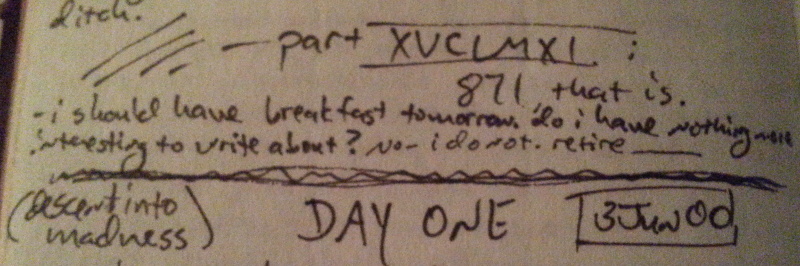
Oouh!The descent into madness
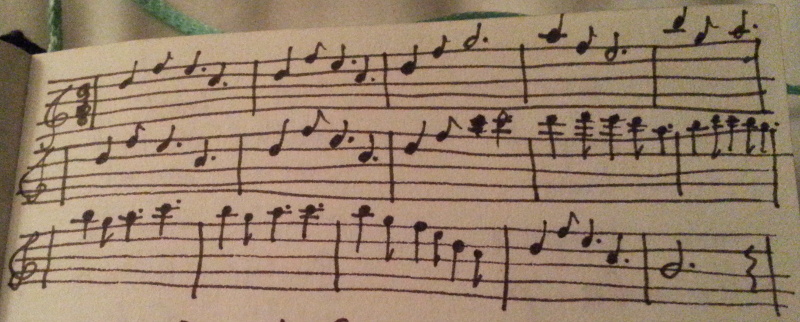
Three yellows, one brown
Children kicking plastic balls
Screaming at pigeons
In Chris’s fingers
One strip of translucent tape
To muffle a child
The cooing flock lights
A blanched dead against the green
Chewing and staring
Plump as a pigeon
A child squeals in the distance
Ready for roasting
Bland, loud and selfish
Soulless husks bawling for bread
Which could feed them all
Fucking Australia, miles from Muenchen, from the Condor, 1 2 Snap, the summation of my past two months. A whirlwind has taken me from life to life, as if they have no connection at all besides my singular presence in both.
5.35pm – we board the bus of death.
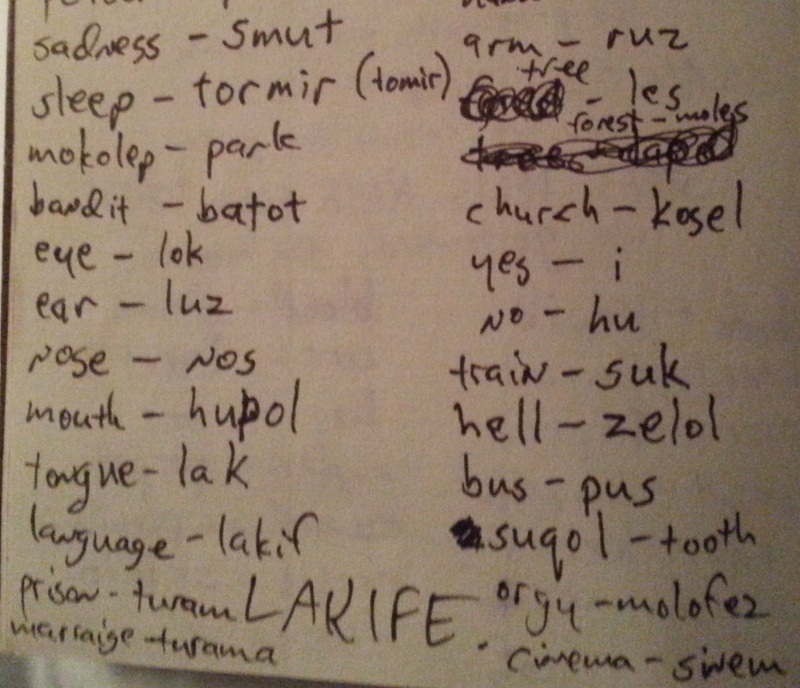
KURAFE KON IS JETZ! The prostitute is with you.
KURAFE SOL KON SOLET JETZ. The prostitutes are with us.
SOLAN QIN KOLEPE NIS. They are inside the pigeon.
SOLET PELIS KASE SOL TOPEN. We go towards the houses.
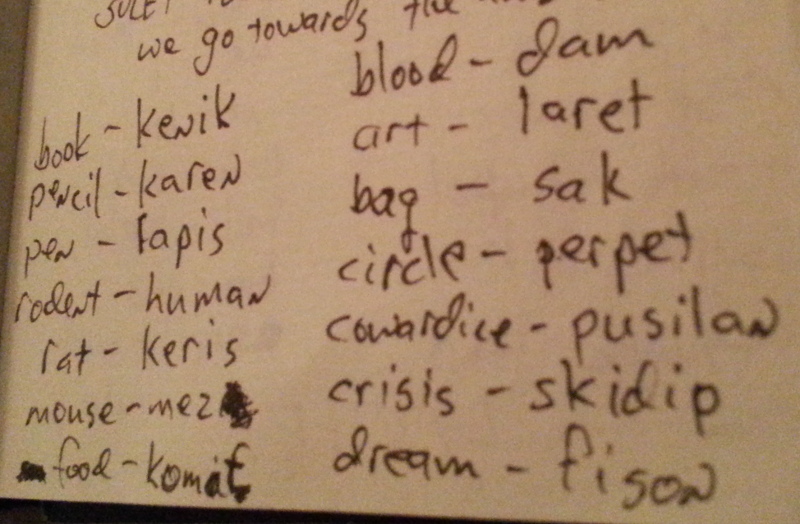
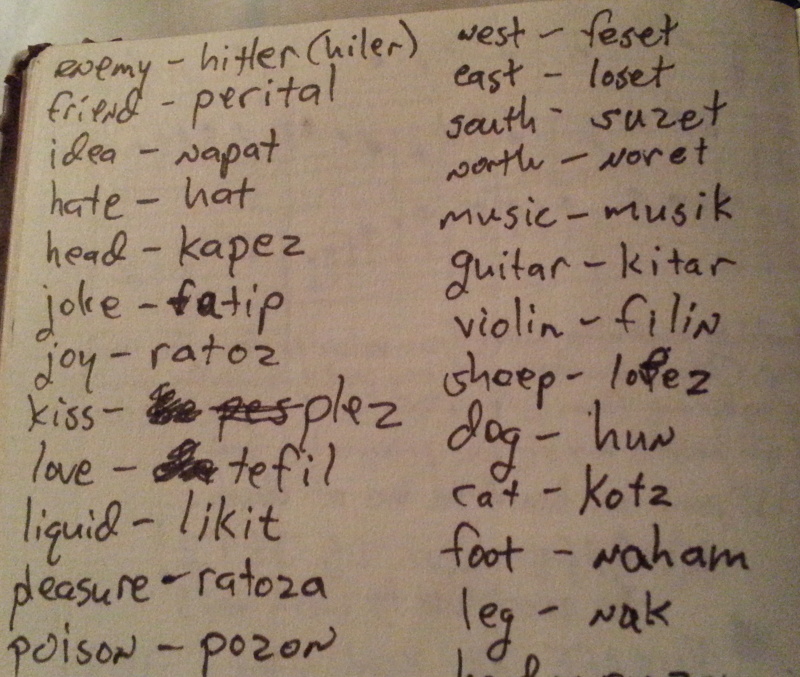
Noun affixes:
- diminuative –> + otz * superlative –> + uk * derogatory –> + ax * beautificatory –> + im –> ilm * all –> + ek * not –> + um * interrogative –> + it * indefinite (some) –> + ap * masc / neut / fem –> + u + o + a * definite (the) –> + (j)e
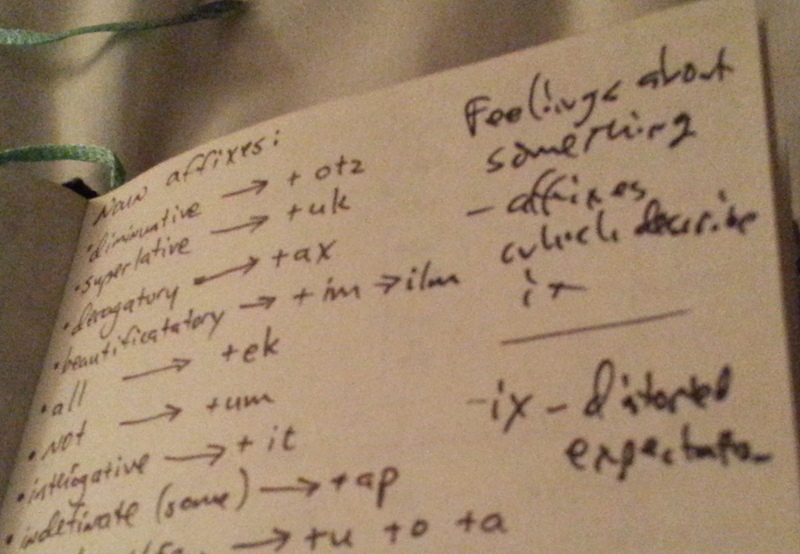
Plez … kiss.
Plezotz … little kiss.
Plezim … Very nice kiss.
Plezit … Which kiss?
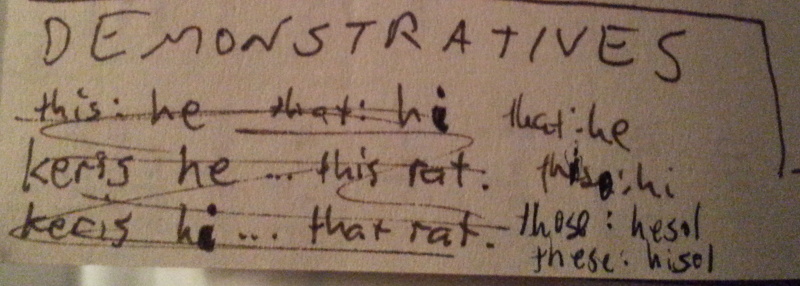
Kerisax … disgusting rat.
kerisukax … big disgusting rat.
kerisukaxit … which big disgusting rat?
kerisotzek … all little rats.
kenikime … the wonderful book.
mezotzaje … the little female mouse.
Ordering: noun + dim / sup + der / beaut + all / inter / indef + gender + def.
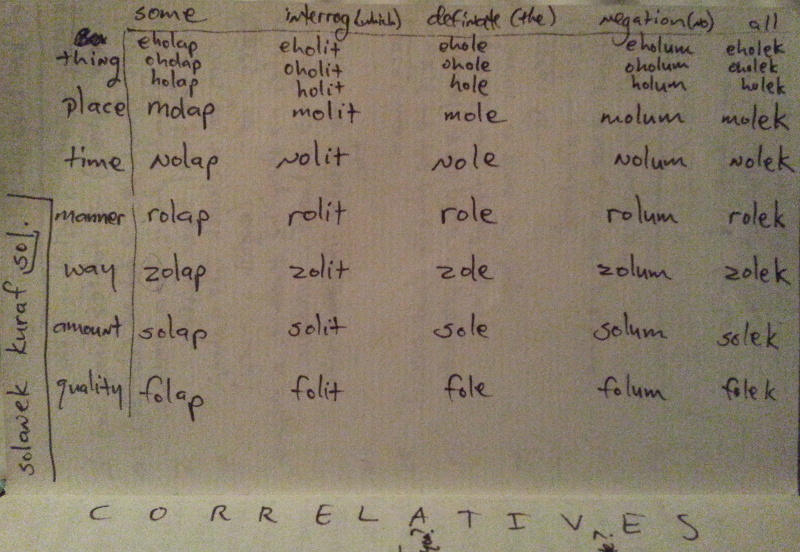
Animate thing - ehol
Inanimate thing - ohol
Thing - hol (concept)
Place - mol
Time - nol
Way - zol
amount - sol
quality - fol
Some (indefiniteness) –> tap
Interoggative –> + it
Definite –> + e
Negative –> + um
Collective –> + ek
Eholit is? –> Which (animate thing) are you?
Holit an? –> What is it?
Et Fek mokife topen nolap. –> Sometime I (will) go to the pub.
Solet fek mokolep topen nolum. –> We never go to parks.
Solit kurafe? –> How much is the prostitute?
hmmmmm…. bad….
Solit kuraf? –> How many prostitutes?
Solum. –> None.
Is fek molit topen? –> To where do you go?
Et fek molum topen nolek. –> I always go nowhere.
Nokife nolek. –> The time to drink is always.
Et kon kolep sol jetz nolek.
Quality: fo- (english… -like)
lofez (sheep) –> folofez (sheeplike)
kuraf (prostitute) –> fokuraf (slutlike)
Ana fokuraf. –> she is like a prostitute.
Chris fek kosel topen folofez. –> Chris goes to church like a sheep.
Degree: so- (english … -ness)
Solofez –> sheeplike tendencies or sheepness.
Kuraf –> sokuraf … slutness.
Sokif –> Alcohol like tendencies.
Etc.
Place: mo-
Mokif –> The place to drink alcohol.
Mokuraf –> The place of prostitutes.
Moperital –> A friendly place.
Motormir –> Place of sleep.
Person: fe-
Fekif –> drunkard.
Fekuraf –> One who does prostitutes.
Fekosel –> Churchgoer.
Genetive case:
Liz. With sol, it agglutinates as -iz. With pronouns, it also agglutinates as -iz.
- etiz - mine. of me. * isiz - of you. yours. * aniza - hers. of her. * solyziz - of us [but not you].
Kase kotze liz. The cat’s house.
Kase kotze soliz. The cats’ house.
Kase sol kotze soliz. The cats’ houses.
An kenik etiz. It is my book.
Ana kuraf Chris liz. She is Chris’s prostitute.
Mofek … at the place.
- Chris fek mokurafe topen. Mofek kurafe anizu. * Chris goes to the bordel. There is his prostitute.
Nofek … at the time.
Zonuz … by this way or means.
- Solet qin suke topen. Zonuz fek zelol topen. * We enter the train. By train (we go) to hell.